Your €2.50 Coffee Is Not Expensive. It's Subsidised.
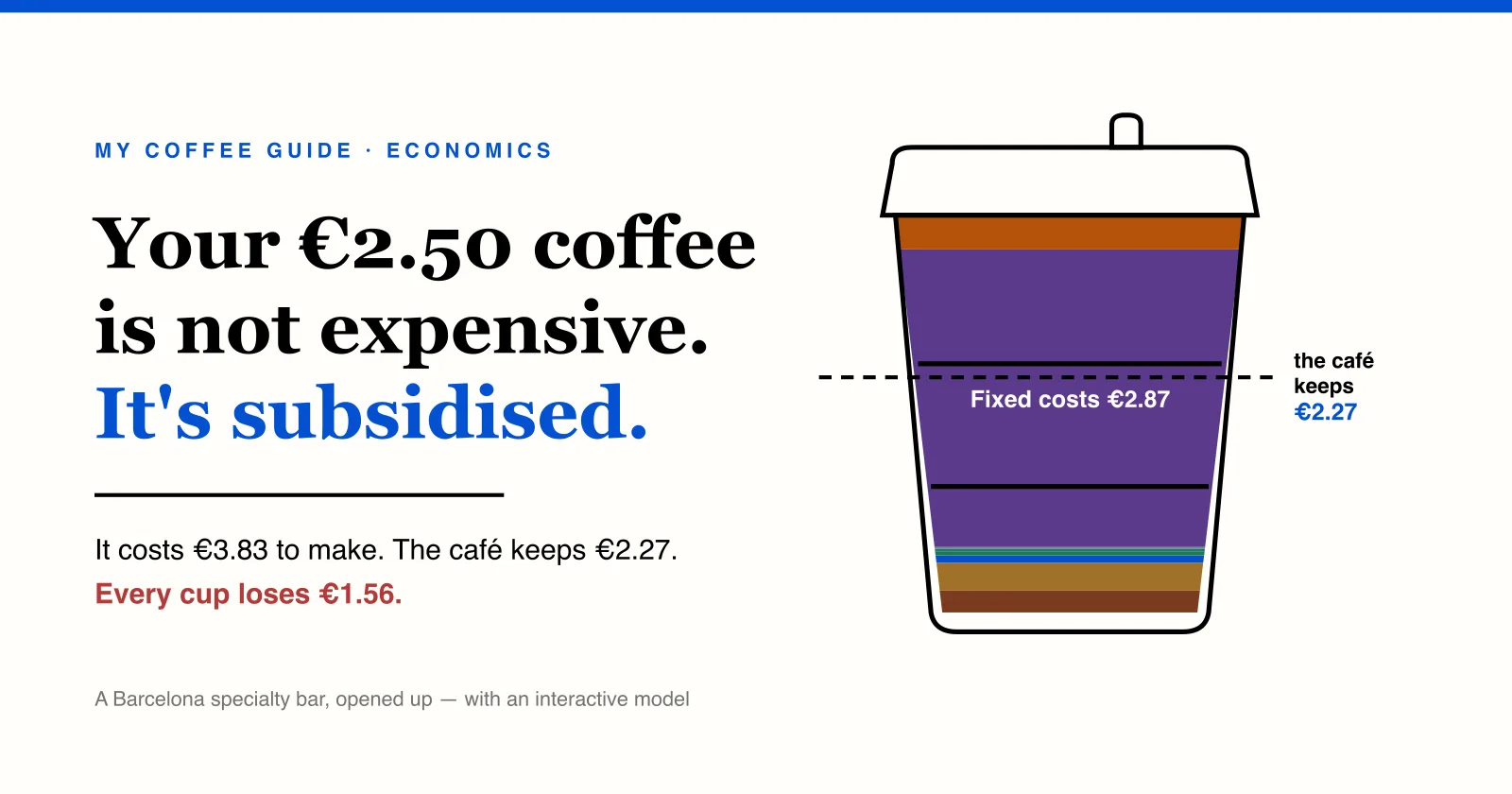
Let's say the thing nobody in this industry wants to say out loud: a significant percentage of specialty coffee shops are losing money on every single cup they sell.
Not because they're badly run. Not because the beans cost too much or the barista is overpaid. But because the numbers — the real numbers, not the ones people talk about at coffee events — simply don't add up at the prices most cafés are charging.
I spent the last few months building an economic model around a real specialty bar in Barcelona. Not a theoretical one. Sixteen seats, one barista, owner behind the counter, specialty beans at €23/kg, a La Marzocco on the bar, good oat milk, a decent street. The kind of place that would earn at least one bean in our Bean Grading System. The kind you walk out of thinking: that was worth €2.50.
Here's what the numbers actually say.
The €2.50 cup, opened up
Quick note before the numbers: in Spain, around 80% of coffees are served with milk. Cortado, café con leche, cappuccino, flat white. The espresso shot is a unit of production, not the finished drink. So when we talk about the cost of a cup here, we mean the most common thing a café actually sells — a milk-based drink, built on a single 9g dose, at €2.50.
The customer pays €2.50. But €0.23 of that goes straight to Hacienda — IVA, collected by the café on behalf of the state. It was never theirs to keep. A lot of small operators don't separate this mentally, especially in the early years. That confusion compounds everything else.
So the café's actual revenue per drink: €2.27.
The same logic works in reverse on the cost side. Every input the café buys — beans, milk, packaging, equipment — carries IVA that the café paid upfront but can recover. Beans at €23/kg actually arrive at €27.83 with IVA, but the café gets that €4.83 back through the quarterly liquidación. The net cost stays at €23. Same with the La Marzocco, the fit-out, the cleaning supplies. The IVA system partially cushions the cost stack through input credits — which is why all figures in this model are presented net of IVA on both sides. What the café collects, what it spends, what it owes Hacienda at the end of each quarter: it's always the net that matters.
Here's what it costs to make that drink:
Cost itemPer cup Coffee beans (9g single dose, €23/kg specialty)€0.21 Milk blend (whole + oat, 40% oat rate)€0.27 Packaging (cup, lid — 55% takeaway rate)€0.07 Sweeteners and syrups€0.04 Water and utilities€0.02 Waste and spillage (3%)€0.02 Total variable cost€0.63
€2.27 minus €0.63 leaves €1.64. That sounds fine. Healthy, even.
Then the iceberg appears.
The iceberg
Before this café pulls its first shot of the day, it already owes:
Fixed costMonthly Rent€2,000 Staff (1 full-time barista)€2,100 Owner salary€1,800 Electricity and gas€420 Water€90 Internet, POS, software€120 Insurance€110 Gestoría€200 Marketing€200 Cleaning and supplies€130 Waste disposal€60 Miscellaneous€200 Equipment amortisation€906 Annual layoff provision€350 Total monthly overhead€8,686
At 105 drinks a day, 310 days a year, that's around 2,712 drinks a month. Fixed cost per drink: €3.20. Add the variable costs: €3.83 total cost per drink.
The café nets €2.27 per drink. On coffee alone, it's losing €1.56 on every single one it sells.
Coffee alone is the important qualifier. Food and retail change that number, and we'll get to them — but they change it by paying part of this bill, not by making the coffee profitable.
The trap nobody puts in the business plan
That amortisation line needs unpacking. The equipment alone — machine, grinder, brew bar, reverse osmosis, refrigeration, POS, fit-out — comes to €47,800. Over 9 years, that's €443/month. Not fun, but survivable.
Then comes the traspaso.
In Barcelona, taking over a viable commercial space means paying the previous tenant for the right to be there. In many good specialty locations that number is €70,000–€80,000. The landlord knows you need the space. The previous tenant knows it too. You can bring it down — by finding spaces that haven't been converted yet, going direct to building owners instead of agents, or trading a lower traspaso for a heavier fit-out — but it takes work and time. Our model uses €50,000, which is achievable but not a given.
Total capex: €97,800. Monthly amortisation: €906. The traspaso alone accounts for €463 of that every month — around 280 coffees, eleven a day — just to cover the cost of buying the right to open. Before you pull a single shot.
It doesn't show up on the menu. But it's in every cup.
The math of survival
To cover every cost at €2.50 — rent, staff, owner salary, equipment, the traspaso — this bar needs to sell around 205 drinks per day if coffee is all it sells. That's not 205 espresso shots. That's 205 revenue-generating transactions across 9 hours of service, on a bar that seats 16 people. In a city where foot traffic has seasons, where the street matters more than the coffee sometimes, and where a rainy Tuesday can cut your numbers in half.
Add the food and the retail bag this model assumes — roughly a third of customers taking a €4.50 pastry, one 250g bag a day — and the number drops to 126. That gap, 205 against 126, is the entire argument of the next section.
At 30 cups a day, fixed cost per drink hits €11.21. You lose money on every transaction. At 200 cups a day, it drops to €1.68. The model starts to work.
Volume isn't just one lever among many. It's the lever. Every extra drink sold is worth dramatically more than the one before it, because the fixed costs don't move.
Food is not a compromise — it's what keeps the lights on
This is something the specialty world has been slow to accept, maybe because it feels like a concession. It isn't.
When a customer adds a €4.50 pastry to their order, the gross margin on that item (around 70% on baked goods) contributes roughly €1.01 of fixed-cost relief per coffee sold — assuming about 35% of customers do it. That's not a nice-to-have. It's the difference between a café that bleeds slowly and one that stays open.
One 250g bag of specialty coffee sold per day — at €11.50, with a gross margin of around €2.40 — covers €62/month of overhead. That's 38 fewer drinks this café has to sell to survive.
Every pastry. Every retail bag. Every oat flat white priced €1 above the cappuccino. Not upsells. Oxygen.
Try the numbers yourself
This is the model the article is built on. Change the rent. Change the volume. Add food. Remove the traspaso. Watch what happens to the margin per cup.
Run your own numbers. If the result is uncomfortable, that's the point. Discomfort is the beginning of a real strategy.
What €2.50 is actually telling you
When a specialty café charges €2.50 for an espresso-based drink in 2025, one of three things is true:
They have the volume, or the mix. Well past 150 drinks a day, with food and retail pulling their weight. This exists. It's not common.
Someone is absorbing a cost that doesn't appear in the price. The owner takes no real salary — and is also the only employee, running the bar alone. The rent is below market: a legacy lease, a family connection. The equipment was inherited. The café is surviving because someone, somewhere, is subsidising it.
They are losing money. And betting that food, retail, reputation, or just more time will eventually close the gap.
None of this makes €2.50 wrong, exactly. But it's a price inherited from a different era — when Barcelona rents were lower, when the café con leche down the street was the competition, when specialty coffee was still proving itself. That era is over.
One more thing the model doesn't show
All the margin and EBITDA figures here are pre-tax. A café that reaches €1.00 of margin per cup — which would be a genuinely good result — owes about 25% of that to Hacienda as Impuesto de Sociedades. The real take-home lands closer to €0.75.
The operating reality is hard enough. The fiscal reality is harder still.
The conversation
Raising prices alone doesn't fix this. A café that jumps to €3.50 without the volume, the product mix, and the operational discipline to back it up will lose customers before it reaches break-even. The math has to hold on multiple fronts at once.
But the conversation has to start somewhere. And the best place to start is with honesty — about what things actually cost, and what it takes to make a specialty café viable in 2025.
And if you're a customer: the next time you hesitate over a €3.00 cortado, you know what went into it.
Frequently asked questions
How much does it actually cost a café to make one coffee?
In this Barcelona model, €0.63 in ingredients and packaging, plus €3.20 of fixed costs per cup at 105 cups a day — €3.83 in total, against €2.27 of revenue once IVA is taken out.
How many coffees does a specialty café need to sell to break even?
Around 205 a day if coffee is all it sells. With food and retail bags carrying their share — a third of customers adding a pastry, one 250g bag a day — the number drops to about 126.
What is a traspaso and why does it matter so much?
In Barcelona, taking over a viable commercial space means paying the previous tenant for the right to be there — often €70,000–€80,000 in good specialty locations. At €50,000 amortised over nine years it adds €463 a month, around eleven coffees a day, before the café opens.
Why do specialty cafés push pastries and retail bags?
Because they pay the fixed costs that coffee alone cannot. A €4.50 pastry taken by a third of customers relieves about €1.01 per coffee sold, and one 250g bag a day covers €62 of monthly overhead.
About the author
Rafael Maggion
Founder, MyCoffee Guide & My Coffee Awards · Team Lead Barista Strategy, Oatly
Rafael Maggion is the founder of MyCoffee Guide and My Coffee Awards, and works as Team Lead Barista Strategy at Oatly for Spain, Portugal and Mexico.
Related articles
No related articles yet.